An examination of the ways that the collection of employee feedback and the use of social media in the workplace affect employee retention and happiness for the June print issue of Talent Management magazine.
---
The Future of Feedback
In an era of modern feedback, organizations that pay heed to employees’ voices and act on their concerns can almost guarantee improved retention.
As signs of a recovering economy emerge and greener pastures beckon, some talent pundits have predicted the long-awaited improvement will lead to a mass exodus of unhappy employees from jobs they’ve grudgingly performed for the last few years. Whether or not “The Great Recession” is followed by “The Great Walk-out” remains to be seen, but by updating the way employee feedback is gathered and — more importantly — acted on, companies have a powerful guard against turnover.
Many of the tried-and-true tools talent managers have been using to gather feedback are still useful, but this is the 21st century. And in this world, the ever-growing reach of technology has left no aspect of life untouched. Employee feedback is no exception, and the following is a guide to the newest tricks and philosophies available to gather, analyze and act on the employee voice.
Plot the Course
Direct feedback can be useful, but before companies draft lengthy annual questionnaires and create accounts with every social media channel, an overview of basic metrics is imperative. Sometimes, those numbers speak volumes — more so than any comments box.
“That is a key thing that we find, over and over again, is missing when it comes time to talk about the macro-level issues around employee dynamics,” said Trey Campbell, North American president of human resource services provider NorthgateArinso. Looking at these metrics is essential as an organization’s first stop when it comes to gathering feedback, he said.
“Before we can even move to the higher-end questions of what’s motivating them, how happy are they, are they an attrition risk, we have to get the basics down,” he said.
Campbell said NorthgateArinso begins its work with a company by first using the core data set from a system of record that all corporations share: payroll. “A foundational building block that we get into very quickly is: ‘Do you know where everyone is and what they do?’” Campbell said this question is increasingly difficult for some companies to answer as businesses grow more global.
Continue reading at Talent Management magazine online!
The Age of Agility
This was a case study for Talent Management magazine about the evolving ways employees at Unilever clock in for work. Originally published in the May, 2012 print edition of Talent Management magazine.
---
Unilever’s flexible work model changed what it means to go to work. Leaders created a place that made employees’ lives better despite increasing pressure to be more productive.
A few years ago global consumer products corporation Unilever realized it needed to expand while cutting costs and carbon output. Now, Unilever employees can work whenever they like, wherever they like, as long as their work gets done.
Unilever calls this “agile working,” and it shifts the emphasis from time and attendance to specific targets and goals, creating a location-independent concept of work. “The idea was to really transform the culture around working at Unilever so the company could be more competitive as a global entity in a very competitive global marketplace,” said Chris Raia, vice president of organizational effectiveness and leader of the company’s agile working program.
But Unilever had to figure out how to unite a workforce spread across nearly every time zone in a way that was convenient for everyone. “Unilever’s business model is one where much of the innovation that the company brings to market is generated by global teams and then implemented in operating companies around the world,” Raia said.
Continue reading at Talent Management magazine online!

Neo flyers up 'til now
The following are all the flyers I've made for Neo events in the last year or so. I've really come to enjoy getting my Photoshop on with these. I think I had the most fun with the one for the holiday party. Fun fact: the Santa Claus in that is the same guy, Charles, as in the Blackout Wednesday poster. The Smiths/Cure one was probably the most difficult, but through that, I taught myself the snap tool, which was way worth it for future projects.


.jpg)


Photo credits:
"Smith-o-Lantern" by Magpie-Moon
Santa Charles by Kelly Reardon
Santa and friend by BD Miller. Models: Charles Kedney and Peggy.
I believe I took the photo of Kitty Zombie from his Facebook photos.
Everything else is stock photography, probably from Corbis.
Vendors: here today, maybe tomorrow
A Q&A with Gartner's James Holincheck about the human capital vendor landscape and how it's affected by technology for Talent Management magazine. This appeared in the April print edition of the magazine.
---
 Today’s turbulent vendor arena, with continuous merging and splitting of companies large and small, is driven by a rapid evolution of technology.
In the 21st century, technology touches all aspects of work as companies strive to find and leverage the next big thing. James Holincheck, managing vice president of research at Gartner, a technology research firm, shared his insights into what aspects of technology have the most impact on human capital management and the vendor community. Emerging technologies such as cloud computing and social networking are driving many larger vendors to tap the savvy and innovation of smaller start-ups that may have their ears closer to the ground.
What is the most important role of a human capital vendor from a talent manager’s perspective?
Holincheck: Most human capital management vendors, of software at least, [provide] technology to help talent managers be more successful in managing talent. That’s the obvious thing. But some certainly do more than that. Some provide various different professional services that help those customers get more out of their investments in technology, or they partner with third parties that can help with that. A technology solution in and of itself is necessary but not necessarily sufficient to be a successful talent manager.
Continue reading at Talent Management magazine online!
---
In the 21st century, technology touches all aspects of work as companies strive to find and leverage the next big thing. James Holincheck, managing vice president of research at Gartner, a technology research firm, shared his insights into what aspects of technology have the most impact on human capital management and the vendor community. Emerging technologies such as cloud computing and social networking are driving many larger vendors to tap the savvy and innovation of smaller start-ups that may have their ears closer to the ground.
What is the most important role of a human capital vendor from a talent manager’s perspective?
Holincheck: Most human capital management vendors, of software at least, [provide] technology to help talent managers be more successful in managing talent. That’s the obvious thing. But some certainly do more than that. Some provide various different professional services that help those customers get more out of their investments in technology, or they partner with third parties that can help with that. A technology solution in and of itself is necessary but not necessarily sufficient to be a successful talent manager.
Continue reading at Talent Management magazine online!
Driving a global diversity culture at Wells Fargo
A Q&A with Wells Fargo's Jimmie Paschall about her career and the D&I objectives of the banking firm for Diversity Executive magazine online.
---
 Jimmie Paschall, Wells Fargo’s executive vice president of enterprise diversity and inclusion, brings a global mindset to making diversity and inclusion an integral part of the employee culture at the financial services firm.
Since starting in her new role at the beginning of the year, Jimmie Paschall has brought a global mindset along with a nonprofit perspective — traits she said she acquired during her time in HR with Marriott International.
Paschall spoke with Diversity Executive about her experience, the nature of the diversity officer role and more.
What led you to this role at Wells Fargo?
Paschall: I started my career with Marriott as a college student in an hourly position and I ended up working for the company the first time around for 17 years, primarily in human resources roles and several business lines that were not lodging business lines. [Then] I had an opportunity to go serve [as] the HR officer for a start-up telecommunications company called XO Communications.
---
Since starting in her new role at the beginning of the year, Jimmie Paschall has brought a global mindset along with a nonprofit perspective — traits she said she acquired during her time in HR with Marriott International.
Paschall spoke with Diversity Executive about her experience, the nature of the diversity officer role and more.
What led you to this role at Wells Fargo?
Paschall: I started my career with Marriott as a college student in an hourly position and I ended up working for the company the first time around for 17 years, primarily in human resources roles and several business lines that were not lodging business lines. [Then] I had an opportunity to go serve [as] the HR officer for a start-up telecommunications company called XO Communications.
The whole package: FedEx's focus on global diversity
A Q&A with FedEx's Shannon Brown about their diversity practices for Diversity Executive magazine online.
--
 FedEx’s Shannon Brown, senior vice president and chief HR/diversity officer, delivers a lesson on what it takes to be culturally relevant on a worldwide scale.
Who: Shannon A. Brown
What: Senior vice president and chief HR/diversity officer, FedEx Express
When: Dec. 4, 1978
Size of company/Number of employees (approx.): More than 151,000 worldwide
What special experiences or qualifications do you feel you bring to the D&I picture of your company?
Brown: I started working at FedEx as a handler in the Memphis Hub. As a man of color, my success here derives from working at a company that embraces diverse viewpoints, ideas and backgrounds of our employees — on a global perspective. In fact, embracing diversity and inclusion is fundamental to the company’s business success and continues to fuel our spirit of innovation.
Continue reading at Diversity Executive magazine!
--
Who: Shannon A. Brown
What: Senior vice president and chief HR/diversity officer, FedEx Express
When: Dec. 4, 1978
Size of company/Number of employees (approx.): More than 151,000 worldwide
What special experiences or qualifications do you feel you bring to the D&I picture of your company?
Brown: I started working at FedEx as a handler in the Memphis Hub. As a man of color, my success here derives from working at a company that embraces diverse viewpoints, ideas and backgrounds of our employees — on a global perspective. In fact, embracing diversity and inclusion is fundamental to the company’s business success and continues to fuel our spirit of innovation.
Continue reading at Diversity Executive magazine!
Finding a home for diversity at Freddie Mac
A Q&A with Freddie Mac's Suzanne Richards about their diversity practices for Diversity Executive magazine.
---
 Suzanne Richards, vice president of diversity and inclusion at the mortgage giant, talks about its collaborative group programs to engage both leaders and employees in everyday diversity.
Who: Suzanne Richards
What: Vice President of Diversity and Inclusion, Freddie Mac
When: Since June 2011
In what areas do you place special emphasis on diversity and inclusion at Freddie Mac?
Richards: For the first time, each of Freddie Mac’s 14 divisions, working with our office of diversity and inclusion, created its own diversity plan tailored to meet division needs. This will ensure that all levels and areas of the company are making diversity a priority and helping Freddie Mac realize its overall diversity and business goals.
We’ve also ramped up our supplier diversity program to strengthen our business. In 2011, we increased our expenditures with diverse suppliers and vendors by more than 50 percent over the previous year.
Another area of focus for us is our employee network groups (ENGs). After an extensive review of ENG participation and efficacy, we re-launched our ENGs at the end of 2011, with a renewed focus on leadership. All of our ENG executive sponsors are members of the firm’s management committee. By engaging senior leaders to lead the ENGs, we are ensuring effective coaching, mentoring and sponsorship of ENG members, as well as providing an active forum for developing and showcasing the future leaders of Freddie Mac.
Continue reading at Diversity Executive magazine!
---
Who: Suzanne Richards
What: Vice President of Diversity and Inclusion, Freddie Mac
When: Since June 2011
In what areas do you place special emphasis on diversity and inclusion at Freddie Mac?
Richards: For the first time, each of Freddie Mac’s 14 divisions, working with our office of diversity and inclusion, created its own diversity plan tailored to meet division needs. This will ensure that all levels and areas of the company are making diversity a priority and helping Freddie Mac realize its overall diversity and business goals.
We’ve also ramped up our supplier diversity program to strengthen our business. In 2011, we increased our expenditures with diverse suppliers and vendors by more than 50 percent over the previous year.
Another area of focus for us is our employee network groups (ENGs). After an extensive review of ENG participation and efficacy, we re-launched our ENGs at the end of 2011, with a renewed focus on leadership. All of our ENG executive sponsors are members of the firm’s management committee. By engaging senior leaders to lead the ENGs, we are ensuring effective coaching, mentoring and sponsorship of ENG members, as well as providing an active forum for developing and showcasing the future leaders of Freddie Mac.
Continue reading at Diversity Executive magazine!
This year, don't think resolution -- think revolution.
A newsletter piece originally published on Talent Management magazine online about corporate New Year's resolutions.
---
 How many of us have given up on new year’s resolutions because they simply don’t stick? Well, forget about resolutions. Here are five ways to revolutionize your new year.
Personal resolutions don’t fulfill themselves — investing in a gym membership isn’t the same as showing up and getting on the elliptical. The same is true for businesses. Simply setting vague goals in a post-holiday meeting and throwing money at them won’t make them realize themselves.
Here are five ways talent managers can ensure their goals don’t suffer the same fate as some folks’ plans to swim the English Channel.
Make the “how” the goal. According to Paul David Walker, a business adviser, Genius Stone Partners founder and author of Unleashing Genius: Leading Yourself, Teams, and Corporations, a company’s resolutions are something to be worked toward with every action.
“People can’t relate to a number; there’s no ‘how’ in a number,” he said. The activities that lead to that number or goal are the goals themselves, Walker said. “You have to have a visceral description of how that will happen, and it needs to be in the present tense. Because if you say, ‘I will’ or ‘we will,’ you push it into the future.” Brainstorming the steps needed to reach a goal, then making those steps into a clear plan will make initiatives easier for clients or employees to follow and get excited about.
Culture of communication. This is most effective when the entire workforce is on board — something that can’t be achieved unless management is actually listening. This isn’t something that can be faked, but requires a collective shift in the culture of a company toward one where every member of the team feels valued and heard, Walker said.
“It’s really critical that you establish a relationship with your employees, that you’re open to hearing all their ideas and thoughts,” he said. “You have to create the environment that encourages people to speak up.”
The key is cutting egos from the conversation and resisting the urge to shoot down an idea immediately. “A big part of that is when someone does share, even if it is totally stupid — which sometimes it is — never make the employee wrong.”
Continue reading at Talent Management magazine!
---
Personal resolutions don’t fulfill themselves — investing in a gym membership isn’t the same as showing up and getting on the elliptical. The same is true for businesses. Simply setting vague goals in a post-holiday meeting and throwing money at them won’t make them realize themselves.
Here are five ways talent managers can ensure their goals don’t suffer the same fate as some folks’ plans to swim the English Channel.
Make the “how” the goal. According to Paul David Walker, a business adviser, Genius Stone Partners founder and author of Unleashing Genius: Leading Yourself, Teams, and Corporations, a company’s resolutions are something to be worked toward with every action.
“People can’t relate to a number; there’s no ‘how’ in a number,” he said. The activities that lead to that number or goal are the goals themselves, Walker said. “You have to have a visceral description of how that will happen, and it needs to be in the present tense. Because if you say, ‘I will’ or ‘we will,’ you push it into the future.” Brainstorming the steps needed to reach a goal, then making those steps into a clear plan will make initiatives easier for clients or employees to follow and get excited about.
Culture of communication. This is most effective when the entire workforce is on board — something that can’t be achieved unless management is actually listening. This isn’t something that can be faked, but requires a collective shift in the culture of a company toward one where every member of the team feels valued and heard, Walker said.
“It’s really critical that you establish a relationship with your employees, that you’re open to hearing all their ideas and thoughts,” he said. “You have to create the environment that encourages people to speak up.”
The key is cutting egos from the conversation and resisting the urge to shoot down an idea immediately. “A big part of that is when someone does share, even if it is totally stupid — which sometimes it is — never make the employee wrong.”
Continue reading at Talent Management magazine!
Serving Chicago's underground since 2011.
Since graduation, I've been spending lots of my time doing PR and social media marketing for Neo, "Chicago's oldest nightclub." I've learned a lot about managing a facebook account from the business side and what kind of tactics will get people to sit up and pay attention. I've also been having a blast sharing music and entertainment news with a Chicago rock and alternative audience and basically being lucky enough to be allowed to play in with the folks behind such an iconic Chicago institution.
One of the biggest undertakings has been creating an archive for their amazing collection of advertising materials. Combing through 30+ years of flyers and posters has been a real treat. Here's a flyer I made for a recent event:

Please visit their page to see more of where I've been trying to take their editorial voice and place in the facebook sharing world. And don't forget to fan us!
One of the biggest undertakings has been creating an archive for their amazing collection of advertising materials. Combing through 30+ years of flyers and posters has been a real treat. Here's a flyer I made for a recent event:

Please visit their page to see more of where I've been trying to take their editorial voice and place in the facebook sharing world. And don't forget to fan us!
Beaucoup Chicago
Medill's annual publishing project presents Beaucoup Chicago, the very first local magazine made exclusively for the iPad.
This is my capstone project. I was lucky enough to be able to combine my magazine skills with something as high-tech and cutting edge as this project, for which I was a part of the editorial team. This means I did everything from copy-editing the text for many of the stories in the final draft of the magazine and pitching in with an extra hand for many of the special projects.
This is my capstone project. I was lucky enough to be able to combine my magazine skills with something as high-tech and cutting edge as this project, for which I was a part of the editorial team. This means I did everything from copy-editing the text for many of the stories in the final draft of the magazine and pitching in with an extra hand for many of the special projects.
Life - now in exciting 3D!
 |
| "AIDS Virus - Third Edition" by Ellen Sandor |
Republished by: The Chicago Journal
Chicago artist Ellen Sandor has been bending the dimensions of visual art since the 1980s, creating scientific visualizations of everything from fractal math to viruses.
Driven originally by what she describes as “a healthy appetite for kitsch,” Sandor was fascinated by turn-of-the-century novelties such as lenticular postcards and stereoscopic films. She set out to develop ways to include similar alternative effects in her work.
Learning to regulate emotions may offer comfort to those with developmental challenges
 |
| Rubbing "Weeping Yogi" statues such as this one is thought to bring comfort to the distressed. (Jessica Krinke/MEDILL) |
Republished in: Get Healthy Magazine (Northwest Indiana Times)
"We have all a better guide in ourselves, if we would attend to it, than any other person can be.” -Mansfield Park, Jane Austen
I often recall a duck cruising along a placid lake when trying to describe living with ADHD. It appears calm, daydreaming on the surface while kicking frantically underneath.
New options give The Pill a rebirth at 50
 |
| Evaluating life with hormonal birth control 50 years later. (Jessica Krinke/MEDILL) |
WATCH: Dr. Debby explains more about The Pill
The Pill celebrates its 50th birthday this year yet understanding regarding the ins and outs of hormonal birth control still remain in adolescence.
While just as effective as it’s always been, it’s not your mother’s pill anymore.
If you can't beat 'em, stop 'em where they stand
 |
| Human breast cancer cells treated left to right with dasatinib. The same samples are dyed to highlight different proteins. Photo courtesy of Dr. Corey. |
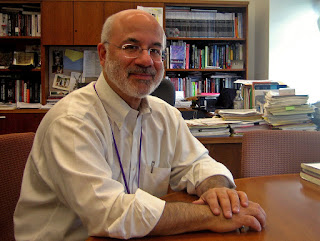
Researchers at Northwestern University are pioneering ways to shoot out the tires from breast cancer’s getaway car in a high-speed chase of drug assassins and carcinogenic criminals.
 |
| Dr. Seth Corey, M.D. |
That’s because breast cancer itself doesn’t kill until it metastasizes, or travels, to other sensitive organs, invades and then grows. But a new clue to stopping this destructive spree surprisingly came from children.
Dr. Seth Corey is a pediatric oncologist at Children’s Memorial Hospital and professor of cellular and molecular biology at Northwestern University’s Feinberg School of Medicine. He and his researchers saw similarities between the travels of breast cancer and another notorious roamer – leukemia. They found that dasatinib, a drug already used to eliminate leukemia in the bone marrow, may also prevent mobility in breast cancer, keeping it from jumping the mammary ship to invade vital organs and kill.
But even though dasatinib is FDA-approved for the treatment of leukemia, the likelihood of your doctor prescribing it for breast cancer just yet is slim. The Northwestern research team hopes to take advantage of dasatinib’s clinical breast cancer trials to determine what responds best. By mapping the biological signatures of varying cancer types this way, fingerprints of these malignant flight-risks to assist in diagnosis and further targeted treatment may not be far off.
Grains of change: Northwestern researchers craft the future of plastics
 |
| J. Mirian Diop, a graduate student with Northwestern University’s Torkelson’s Research Group, adjusts the construction of a screw for the lab’s “extruder,” a gadget that combines polymers molecularly. Diop left an industrial chemical engineering career to pursue environmentally beneficial research. (Jessica Krinke/MEDILL) |
Northwestern University’s Torkelson Research Group has big plans for those tiny grains. Diop and her colleagues think that someday the work done here will change the way the world produces and recycles much of its everyday plastic products.
After each tweak of the mixture, Diop sets up again for another three-hour test beneath the lab’s florescent lights and concrete walls lined with machinery parts and trays of various granulated plastics.
Right now, the conventional way industry creates plastics is to melt down the specific polymers (science for plastic) needed and blend them with dyes until the mixture is the desired color and consistency.
Rock local - open mic night at Rogers Park's Red Line Tap
Final project for Wynne Delacoma's arts reporting class. The assignment was to make a video or slideshow about a live performance. I chose slideshow because it forces you to listen to the performances more and, to me, it's easier to make someone "there" with just pictures and sounds sometimes.
By the way, in case you're wondering why Brad Norman's voice sounds familiar, he now plays "Chad Ridgeway," the broker character in the Scottrade commercials. He told me during our short interview that he had just done an audition in California that he was waiting to her back about. I guess it went well. Good for him.
By the way, in case you're wondering why Brad Norman's voice sounds familiar, he now plays "Chad Ridgeway," the broker character in the Scottrade commercials. He told me during our short interview that he had just done an audition in California that he was waiting to her back about. I guess it went well. Good for him.
Alley Cat: Mark Thomas's lucky 7
 |
| Click to enlarge! |
Thomas owns The Alley, the collection of punk/kitch/whatever stores on the corner of Belmont Ave. and Clark St. in Chicago that have attracted generations of suburban teens on their first pilgrimages to the big city.
After minding hell’s gift shop for three decades, Chicago’s godfather of alternative culture has enough keepsakes to fill four offices and stories to fill each one of his many shops. High above the driving music and scent of leather in the main Alley store, he reminisces about the toys in his attic.
Harder, better, faster, stronger: I:Scintilla grows with age, but is the world ready?
 |
| I:Scintilla press photo/ISCINTILLA.COM |
Industrial corn school transplants I:Scintilla have a cult following and goth cred to spare. Too bad everyone around them doesn’t seem to be up to their level.
The 1300 block of West Lake Street is an odd place for an underground music venue. Not as out-of-place as Chinatown is for Reggie’s, but almost.
A family like his
Medill Reports: Chicago
Kijan Jonovich is a natural musician. Though he’s not old enough to talk much, he scoots his toddler-sized racecar across the wood floor and sings along as it plays “The Wheels on the Bus.”
But the batteries in the car are dying and as he turns the big yellow key that plays the song again and again, rolling his hands over each other at the part that goes “round and round,” the wheels on this bus sound like they’re melting. The sound becomes more and more garbled and strained and it seems Kijan’s little friend needs a jump. Mom decides that’s enough.
Two doors down, two different worlds
Medill Reports: Chicago
Story by: Abby Sewell
Video production: Jessica Krinke
It’s dusk on West Lawrence Avenue, and Wafeeqa Saadeh is preparing to close up shop for the night.
Saadeh, a Palestinian immigrant who settled in the neighborhood in 1978, runs the El-Jeeb Hijab and Gifts with a handful of relatives, including her sister, niece and nephew. Her small, family-owned store in Albany Park is crowded with embroidered robes and head scarves imported from Jordan. It’s one of a handful of spots in Chicago that specialize in Muslim women’s clothing. The family has also owned a grocery store in the neighborhood for 25 years.
Two storefronts down, behind an unobtrusive façade bearing the legend “Admiral Theatre,” in a high-ceilinged lobby done up in blue and gold, cashiers are setting up for the night. Scantily clad Egyptian sirens watch them from the paintings on the walls. In a little while, tourists, businessmen, sailors and college boys heading out for a night on the town will begin lining up for another show at Chicago’s oldest strip club.
Story by: Abby Sewell
Video production: Jessica Krinke
It’s dusk on West Lawrence Avenue, and Wafeeqa Saadeh is preparing to close up shop for the night.
Saadeh, a Palestinian immigrant who settled in the neighborhood in 1978, runs the El-Jeeb Hijab and Gifts with a handful of relatives, including her sister, niece and nephew. Her small, family-owned store in Albany Park is crowded with embroidered robes and head scarves imported from Jordan. It’s one of a handful of spots in Chicago that specialize in Muslim women’s clothing. The family has also owned a grocery store in the neighborhood for 25 years.
Two storefronts down, behind an unobtrusive façade bearing the legend “Admiral Theatre,” in a high-ceilinged lobby done up in blue and gold, cashiers are setting up for the night. Scantily clad Egyptian sirens watch them from the paintings on the walls. In a little while, tourists, businessmen, sailors and college boys heading out for a night on the town will begin lining up for another show at Chicago’s oldest strip club.
Subscribe to:
Posts (Atom)